A History of Fun Packed Curriculums
2025/26
SPRING TERM
A History of fun curriculums Spring Term 2026
Music
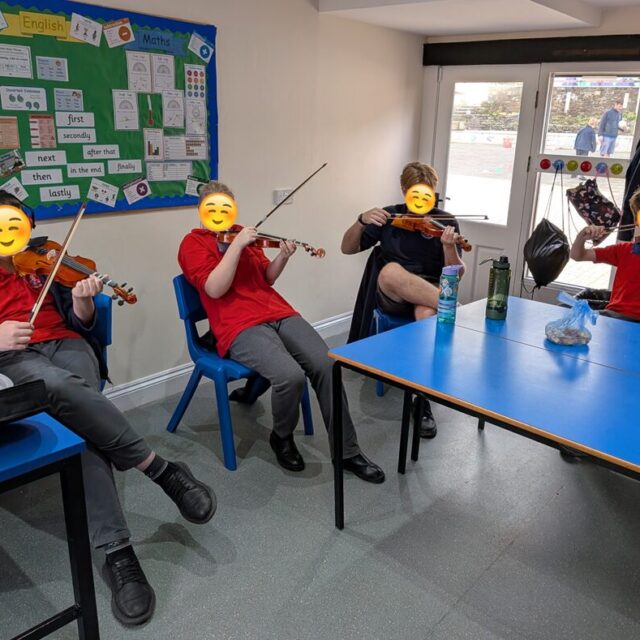
During the Spring terms we have been exploring different instruments using the Charanga ‘I Wanna Play in a Band’ unit of work. Children have been learning to play the PBuzz, using the Charanga First Notes to First Band programme for PBuzz. They have also asked to learn how to play the fife and the keyboard. The fife proved quite tricky, so recorders were practiced on instead.
Children also asked to revisit the otamatone – we have been using colour notation with corresponding stickers on the otamatone to help us play simple melodies and familiar songs.
To tie in with the science topic of “materials”, children have been exploring about plastic pollution and created their own song about the dangers of plastic pollution to nature and the environment.
Songs the children have been playing along to include “We Will Rock You” by Queen, “Smoke On The Water” by Deep Purple, “Rockin’ All Over The World” by Status Quo, “I Saw Her Standing There” by The Beatles, “Can’t Stop the Feeling” by Justin Timberlake, “Me Myself and I” by De La Soul, and “U Can’t Touch This” by MC Hammer.
We have also explored reggae using the Charanga ‘Zootime’ unit of work. Songs we have learned include “Zootime” by Joanna Mangona, “Kingston Town” by UB40, and “I Can See Clearly Now” by Jimmy Cliff.
Design Technology
Some children have been designing and creating their own “cracking contraption”, based around the ideas from the characters of Wallace and Gromit. They will undertake their own design, write an explanation of what it is and how it works, and then create a model of their own “cracking contraption”.
Other pupils have been designing a toy car for a child; prototyping, improving and evaluating their own design online and then using the 3D printer to bring it alive.
A further group of pupils have looked at real dice, thought about what they use dice for, and then used this information to design their own dice, 3D printing it and then painting it according to their plans.
Science
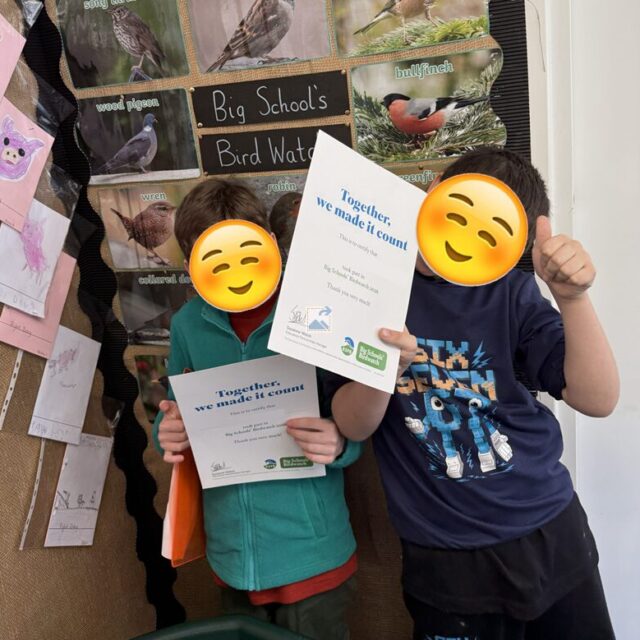
All groups of children took part in the Big School Bird watch in February in their science lesson at Tivington Farm. Teaching staff were particularly impressed by the children’s’ enthusiasm and ability to identify birds.
In school, we have been able to run a couple of investigations looking into what soil is made from, and the hardness of rocks: pupils tested the soil contents of our school field by soaking in water and leaving it to settle into layers.
We have also surveyed the field, looking for different types of seeds we could find, and studied some small plants from our local environment, carefully removing them from the ground, naming their different parts, and then dissecting and observing their parts from different perspectives.
English
Some of our early readers have memorised the story ‘A mouse called Julian’, while some others have been learning all about instructions and feelings with the book ‘How to Wash a Woolly Mammoth.’
Slightly older children have been reading non-fiction texts to help them develop their informative and persuasive writing skills, including “Dear Greenpeace”, “Dear Teacher”, “Top 10 Nastiest Pirates”, and “True Pirate Stories”. The children have written letters, and focused on information text writing about factual characters from history. They will be moving onto related fiction such as “Treasure Island” in the summer terms.
Another group of children have been using the picture book “Leo and the Octopus” by Isabelle Marinov as a stimulus for writing in English.
The children have been writing for a range of purposes including letters, diaries, log books and fact files.
“Leo and the Octopus“ follows Leo, a young boy who often feels out of place in a noisy and overwhelming world. Leo struggles to understand his classmates, and they struggle to understand him. His life changes when he meets Maya, a colourchanging Giant Pacific Octopus, and through their friendship, Leo begins to feel less alone and more connected to the world around him.
Reading this book has encouraged lots of really interesting conversations about feelings and emotions and how people manage these in different ways. The children really enjoyed reading the story, learning about feelings and emotions and learning lots of interesting facts that they have been able to use in their writing.
Older pupils undertaking NCFE Entry Level 3 English have read a range of fiction and non-fiction to help develop specific reading skills such as skimming & scanning, inference, and identifying text types. All of these students went on to pass their NCFE Reading Assessment.
Maths
Pupils undertaking NCFE Entry Level Maths have been applying their knowledge using a method for the four operations, and have used compasses to apply position and direction learning to our local environment.
World Book Day March 2026
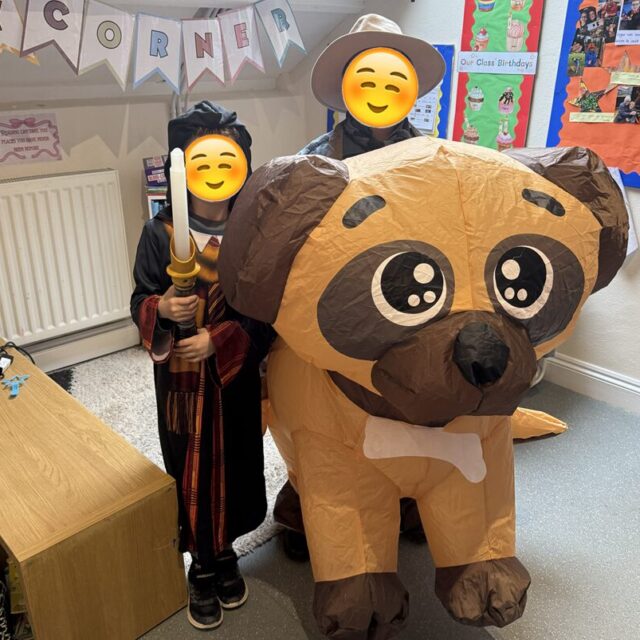
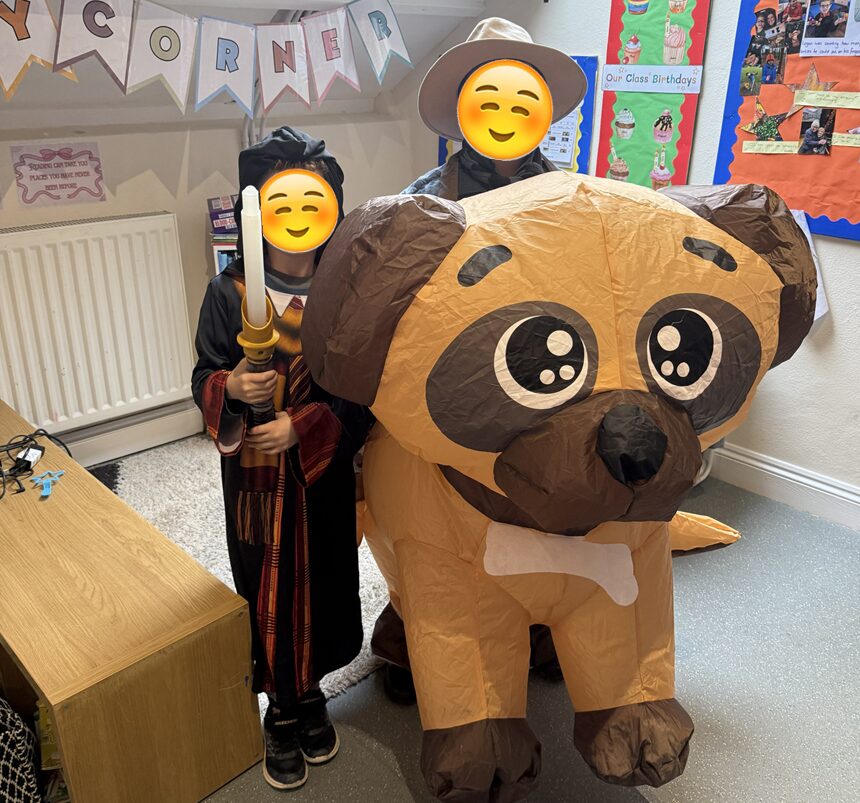
Our children participated in World Book Day in a number of ways this year: dressing up as their favourite book characters; taking part in the World Book Day live draw-along (one tutor group drew individual cartoons of Big Ben and showed superb detail!); and participating in the live online Great Big World Book Day Footy and Booky Quiz 2026.


2025/26
AUTUMN TERM
Careers
On 23rd September, Future Smart Careers visited and spent the morning working with our Year 9 and Year 10 pupils to get them thinking about and planning their future pathways. On 14th October, Kelly from Future Smart Careers returned for a Year 11 guidance day, holding individual meetings with our five Year 11 pupils to provide focused guidance around their post-16 options. One of our Year 11 pupils has started a fortnightly work experience placement in a local North Devon business, and another pupil is continuing a weekly work experience placement at Tivington Farm in West Somerset. A former Year 11 pupil came back into school on the 21st of November to speak to our current Year 10s and 11s about life as a student at Petroc College. There were lots of questions asking how college was different to school, which were answered openly, honestly, and with a touch of humour, helping to put some minds at ease around post-16 education from the perspective of a peer who is experiencing it himself.
Appledore Book Festival
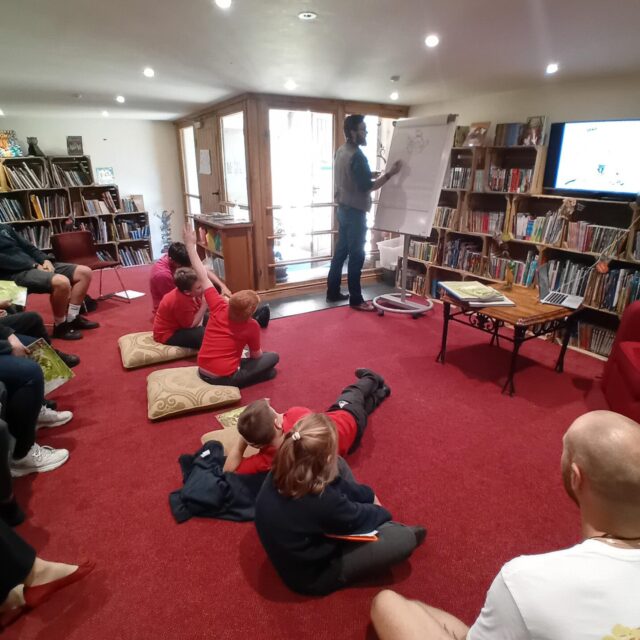
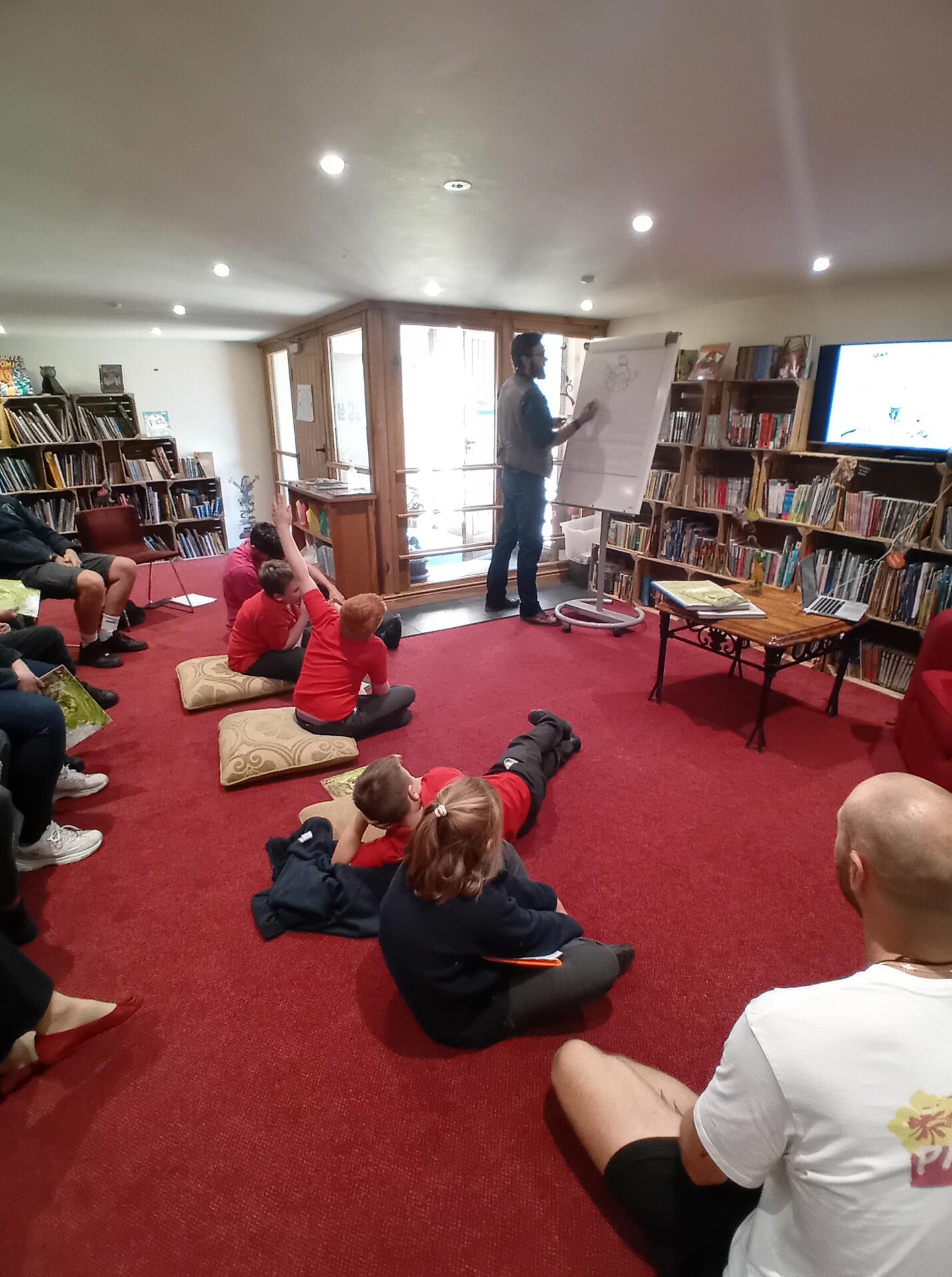
On 26th September, local author Joseph Witchall came in to school as part of Appledore Book Festival and delivered interactive workshop sessions to three groups of children of different ages. He shared his story of being a children’s book illustrator, and recently becoming a published author, showing us his process in coming up with ideas, creating characters, plotting the story, and illustrating the book. Joseph used pupil ideas to create cartoon characters during the workshop, and then pupils created and drew their own characters. A group of our mid-KS2 pupils showed Libra hospitality by having lunch sat outside enjoying the autumn sunshine with the author after the workshops.
Tutor time
A lower KS3 tutor group wanted to share their tutor time programme; they have been reading “Tiger Wars” by Steve Backshall on a Monday, which was requested after starting to read it previously and wanting to continue, as it was such a great story! On Tuesdays, the group find out about current affairs and news stories from around the world. Wednesday is the day the children look at environmental issues involving places and animals, and on Thursday they get the opportunity to play different games. Friday is the day for assembly!
RS/SMSC
This term, Religious Studies and SMSC (Spiritual, Moral, Social and Cultural) lessons have taken place in tutor groups at the end of each term. The aim is to help children explore different faiths and understand the values and beliefs that are important to others. In Term 1, children explored the Christian story of creation, why they believe they should be good, and what the trinity means to them. One of our youngest tutor group thought about two big questions: “What do Christians learn from the Creation story?” and “Why should I be good?” To support learning, they enjoyed reading the story “God’s Very Colourful Creation” by Tim Thornborough. This helped children remember the order in which Christians believe the world was made. The children listened actively, were inquisitive, and showed good understanding.
In RS lessons, it is also an opportunity to discuss what is going on in the world around us; one upper KS2 pupil relayed a local news item about bones being found in woods somewhere in Devon – it was a shocking discovery until they were identified as animal bones. This led to a discussion of the ways in which news spreads, as well as the moral difference between animal and human bones being left in the woods.
In Term 2, with Christmas approaching, children explored the similarities and differences between the Jewish festival of Hannukah, and the Christian celebration of Christmas. It was discovered that symbols are very important to this Jewish festival, especially in the different food dishes that are prepared and eaten; and many children wanted Christmas to last for eight days and nights as Hannukah does!
Farm, including rural art
At the farm in October, our youngest pupils enjoyed cooking and eating pumpkin soup, linking with the story ‘Pumpkin Soup’ by Helen Cooper. Pupils used pumpkins and onions grown at the farm in their recipe and thoroughly enjoyed making and tasting the soup with some asking to take the recipe home! One pupil said, ‘it was the best thing he had ever tasted’. To develop their literacy skills, the following week children wrote up the recipe.
The farm facilitated our annual pumpkin decorating competition; in art lessons at the farm pupils chose a pumpkin, created a design, and then painted their design onto the pumpkin using acrylic paints. There were prizes for KS1/lower KS2, middle KS2, upper KS2, lower KS3, upper KS3 and KS4, with a winner and runner up for each age group. There were also two overall honourable mentions. The standard this year was very high and designs uniquely creative!
In rural art pupils explored the illustration work of Quentin Blake, drawing unique pictures in his style to compliment a story. Groups have also created collaged robots in the style of French artist Erwan Soyer and experimented with mixed media- using wax crayons and watercolour to make a layered Christmas picture.
English
Some stand out moments include the development of handwriting in one lower KS2 group. This has encompassed using a range of strategies including highlighted lines, pencil grips and lots of determination and support to make real improvements this term, which pupils will continue to work on in the coming terms.
In English lessons, the same group of pupils have used a range of texts as a stimulus for writing including the traditional tale “Little Red Riding Hood” and “The (In)Complete Book of Dragons” by Cressida Cowell. Pupils have been inspired to write their own journey stories and dragon reports.
Working on oracy skills in English, an older group of KS2 pupils had a go at making Lego objects, but there was a catch. Only one pupil was allowed to see the picture of what was being built, one collected the Lego from the box, and one built. Looking at each other was not allowed; the only communication was by pupils describing in words!’
Lower KS3 pupils read and learned about King Arthur and what the characteristics of a medieval knight were, including what was expected of them. They created their own characters and studied how they would be challenged by some of the quests knights went on. In the second term pupils move on to read a child friendly version of “Macbeth” and find out what a tragedy is. The decisions Macbeth made, and if they made him a better or worse person, were explored. The pupils particularly enjoyed role play and acting out aspects of the play.
In GCSE English, pupils read “A Christmas Carol” and explored the background and context of Victorian Britain; discussing the themes of redemption, justice, poverty and social responsibility, and identifying Dickens’ writing techniques of a circular structure, slightly sarcastic narrative voice, and recurring motifs.
Pupils studying NCFE Entry Level 3 English practised and completed speaking and listening assessments. The range of topics included a talk on horses, a talk on favourite foods, and an introduction to extreme sports, such as Extreme Ironing!
Maths
Teachers use manipulatives in maths to help bring concepts to life; these are physical tools that can improve the way children think and make sense of a concept and deepen their mathematical understanding, as well as helping them find the answer to a mathematical question. In the early levels, manipulatives that are offered in lessons include counters, number squares and number lines, multi-link cubes, beads threaded onto strings, and money. As pupils move through and up the levels, manipulatives also include rulers, containers, jugs, weights and scales to measure and weigh, calendars, analogue and digital clocks to support learning about time, multiplication grids, place value and fraction cards, and calculators. Wherever we can, we also use our outdoors environment as a resource; measuring objects around school and the school grounds (lengths, angles) and converting between measurements, using metre sticks, tape measures and trundle wheels; finding three dimensional shapes in the manmade and natural environment, using chalk to mark out areas for number based games, and using our newly painted outdoors snakes and ladders board.
Science
An upper KS2 group combined learning about light in science with learning about World War One in history to tell the story of Sergeant Stubby, who was a World War One hero!
In Term 1, a KS3 group designed and participated in some great experiments looking at thermal energy. The pupils designed a study to investigate temperature decrease in cups made from a range of materials, conducted their experiment, and wrote about their findings.
Science at the farm has included younger pupils carrying out pond dipping to observe and record the range of animal life present in the habitat, and making a woodlouse house to understand what animals need to survive. All ages of pupils had a go at using disclosing tablets to understand what plaque is and where it forms, learn why brushing teeth thoroughly is important, and explore how oral hygiene impacts overall health. Older pupils have engaged in a debate on the use of antibiotics in farming, after learning about diseases in wild and farm animals and some of the ways disease can be treated.
Our older pupils have got to grips with microscopes and stethoscopes to help them understand about cells and to compare human and animal heartrates, and carried out an experiment modelling the digestive system using sweet tubes, plastic bags and tights, which were joined together to replicate the different parts of the digestive tract.
PSHE
Younger pupils have read a range of stories and texts to support their learning in PSHE lessons, to encourage love for storytelling and developing interest in reading. We have read a range of stories that have prompted discussions around internet safety, friendship, kindness and being accepting of each other’s differences and identities. Stories we have read have included: The Family Book by Todd Parr, How to Apologise by David LaRochelle, #Goldilocks by Jeannie Willis, Have You Filled a Bucket Today by Carol McCloud and Mud Boy by Sarah Siggs. Listening to stories together inspires discussions and conversations; the children are encouraged to relate to the characters and how they are feeling, leading to a deeper understanding of key concepts.
In PSHE lessons, our older pupils focused on mental health in Term 1 and have been learning about the cost of living and how to manage a budget successfully in Term 2. Pupils found out that even though inflation means prices increase over time, certain items are less expensive now than they were 10 years ago, while the price of some other everyday staple food items has soared way above inflation.
In Libra Life Skills lessons there has been practice at using kitchen appliances independently and safely, and in Maths, learning has included gaining confidence adding, subtracting and rounding money, and converting analogue and digital time, all necessary skills to help prepare for life outside of and beyond school.
Humanities
Topics explored in the Autumn Term included Ancient Greece, finding out about life in Ancient Greece, the roles of men and women, and Greek Gods, World War One, and World War Two. Pupils learned about the implications of war, what conscription was, the roles women played and how family life changed, and the effects of war on people who fought and those who were left behind.
In Term 1 a lower KS3 group studied “A Diary of a (Sort of) Hero” by Tom Vaughn in line with our history topic of Ancient Greece. This text was used to inspire conversations about history, make links to the present day and write diary entries incorporating our learning about Greek gods. In Term 2, the text “Where the Poppies Now Grow” by Hilary Robinson and Martin Impey was read and used to write flashback stories incorporating our learning about the impact of World War One and World War Two. These pupils have created some beautiful pieces of writing linking back to the war; trying hard to use figurative language to create tension and effect to affect our reader.
Our youngest pupils learned about prehistoric Britain, and then The Great Fire of London. The children particularly enjoyed making their own London homes and safely setting light to them in the outdoors learning are at school, creating their own scale model of The Great Fire of London, and seeing for themselves how quickly the fire spread, and how dangerous it was.
On 23rd September, Future Smart Careers visited and spent the morning working with our Year 9 and Year 10 pupils to get them thinking about and planning their future pathways. On 14th October, Kelly from Future Smart Careers returned for a Year 11 guidance day, holding individual meetings with our five Year 11 pupils to provide focused guidance around their post-16 options. One of our Year 11 pupils has started a fortnightly work experience placement in a local North Devon business, and another pupil is continuing a weekly work experience placement at Tivington Farm in West Somerset. A former Year 11 pupil came back into school on the 21st of November to speak to our current Year 10s and 11s about life as a student at Petroc College. There were lots of questions asking how college was different to school, which were answered openly, honestly, and with a touch of humour, helping to put some minds at ease around post-16 education from the perspective of a peer who is experiencing it himself.
Appledore Book Festival
On 26th September, local author Joseph Witchall came in to school as part of Appledore Book Festival and delivered interactive workshop sessions to three groups of children of different ages. He shared his story of being a children’s book illustrator, and recently becoming a published author, showing us his process in coming up with ideas, creating characters, plotting the story, and illustrating the book. Joseph used pupil ideas to create cartoon characters during the workshop, and then pupils created and drew their own characters. A group of our mid-KS2 pupils showed Libra hospitality by having lunch sat outside enjoying the autumn sunshine with the author after the workshops.
Tutor time
A lower KS3 tutor group wanted to share their tutor time programme; they have been reading “Tiger Wars” by Steve Backshall on a Monday, which was requested after starting to read it previously and wanting to continue, as it was such a great story! On Tuesdays, the group find out about current affairs and news stories from around the world. Wednesday is the day the children look at environmental issues involving places and animals, and on Thursday they get the opportunity to play different games. Friday is the day for assembly!
RS/SMSC
This term, Religious Studies and SMSC (Spiritual, Moral, Social and Cultural) lessons have taken place in tutor groups at the end of each term. The aim is to help children explore different faiths and understand the values and beliefs that are important to others. In Term 1, children explored the Christian story of creation, why they believe they should be good, and what the trinity means to them. One of our youngest tutor group thought about two big questions: “What do Christians learn from the Creation story?” and “Why should I be good?” To support learning, they enjoyed reading the story “God’s Very Colourful Creation” by Tim Thornborough. This helped children remember the order in which Christians believe the world was made. The children listened actively, were inquisitive, and showed good understanding.
In RS lessons, it is also an opportunity to discuss what is going on in the world around us; one upper KS2 pupil relayed a local news item about bones being found in woods somewhere in Devon – it was a shocking discovery until they were identified as animal bones. This led to a discussion of the ways in which news spreads, as well as the moral difference between animal and human bones being left in the woods.
In Term 2, with Christmas approaching, children explored the similarities and differences between the Jewish festival of Hannukah, and the Christian celebration of Christmas. It was discovered that symbols are very important to this Jewish festival, especially in the different food dishes that are prepared and eaten; and many children wanted Christmas to last for eight days and nights as Hannukah does!
Farm, including rural art
At the farm in October, our youngest pupils enjoyed cooking and eating pumpkin soup, linking with the story ‘Pumpkin Soup’ by Helen Cooper. Pupils used pumpkins and onions grown at the farm in their recipe and thoroughly enjoyed making and tasting the soup with some asking to take the recipe home! One pupil said, ‘it was the best thing he had ever tasted’. To develop their literacy skills, the following week children wrote up the recipe.
The farm facilitated our annual pumpkin decorating competition; in art lessons at the farm pupils chose a pumpkin, created a design, and then painted their design onto the pumpkin using acrylic paints. There were prizes for KS1/lower KS2, middle KS2, upper KS2, lower KS3, upper KS3 and KS4, with a winner and runner up for each age group. There were also two overall honourable mentions. The standard this year was very high and designs uniquely creative!
In rural art pupils explored the illustration work of Quentin Blake, drawing unique pictures in his style to compliment a story. Groups have also created collaged robots in the style of French artist Erwan Soyer and experimented with mixed media- using wax crayons and watercolour to make a layered Christmas picture.
English
Some stand out moments include the development of handwriting in one lower KS2 group. This has encompassed using a range of strategies including highlighted lines, pencil grips and lots of determination and support to make real improvements this term, which pupils will continue to work on in the coming terms.
In English lessons, the same group of pupils have used a range of texts as a stimulus for writing including the traditional tale “Little Red Riding Hood” and “The (In)Complete Book of Dragons” by Cressida Cowell. Pupils have been inspired to write their own journey stories and dragon reports.
Working on oracy skills in English, an older group of KS2 pupils had a go at making Lego objects, but there was a catch. Only one pupil was allowed to see the picture of what was being built, one collected the Lego from the box, and one built. Looking at each other was not allowed; the only communication was by pupils describing in words!’
Lower KS3 pupils read and learned about King Arthur and what the characteristics of a medieval knight were, including what was expected of them. They created their own characters and studied how they would be challenged by some of the quests knights went on. In the second term pupils move on to read a child friendly version of “Macbeth” and find out what a tragedy is. The decisions Macbeth made, and if they made him a better or worse person, were explored. The pupils particularly enjoyed role play and acting out aspects of the play.
In GCSE English, pupils read “A Christmas Carol” and explored the background and context of Victorian Britain; discussing the themes of redemption, justice, poverty and social responsibility, and identifying Dickens’ writing techniques of a circular structure, slightly sarcastic narrative voice, and recurring motifs.
Pupils studying NCFE Entry Level 3 English practised and completed speaking and listening assessments. The range of topics included a talk on horses, a talk on favourite foods, and an introduction to extreme sports, such as Extreme Ironing!
Maths
Teachers use manipulatives in maths to help bring concepts to life; these are physical tools that can improve the way children think and make sense of a concept and deepen their mathematical understanding, as well as helping them find the answer to a mathematical question. In the early levels, manipulatives that are offered in lessons include counters, number squares and number lines, multi-link cubes, beads threaded onto strings, and money. As pupils move through and up the levels, manipulatives also include rulers, containers, jugs, weights and scales to measure and weigh, calendars, analogue and digital clocks to support learning about time, multiplication grids, place value and fraction cards, and calculators. Wherever we can, we also use our outdoors environment as a resource; measuring objects around school and the school grounds (lengths, angles) and converting between measurements, using metre sticks, tape measures and trundle wheels; finding three dimensional shapes in the manmade and natural environment, using chalk to mark out areas for number based games, and using our newly painted outdoors snakes and ladders board.
Science
An upper KS2 group combined learning about light in science with learning about World War One in history to tell the story of Sergeant Stubby, who was a World War One hero!
In Term 1, a KS3 group designed and participated in some great experiments looking at thermal energy. The pupils designed a study to investigate temperature decrease in cups made from a range of materials, conducted their experiment, and wrote about their findings.
Science at the farm has included younger pupils carrying out pond dipping to observe and record the range of animal life present in the habitat, and making a woodlouse house to understand what animals need to survive. All ages of pupils had a go at using disclosing tablets to understand what plaque is and where it forms, learn why brushing teeth thoroughly is important, and explore how oral hygiene impacts overall health. Older pupils have engaged in a debate on the use of antibiotics in farming, after learning about diseases in wild and farm animals and some of the ways disease can be treated.
Our older pupils have got to grips with microscopes and stethoscopes to help them understand about cells and to compare human and animal heartrates, and carried out an experiment modelling the digestive system using sweet tubes, plastic bags and tights, which were joined together to replicate the different parts of the digestive tract.
PSHE
Younger pupils have read a range of stories and texts to support their learning in PSHE lessons, to encourage love for storytelling and developing interest in reading. We have read a range of stories that have prompted discussions around internet safety, friendship, kindness and being accepting of each other’s differences and identities. Stories we have read have included: The Family Book by Todd Parr, How to Apologise by David LaRochelle, #Goldilocks by Jeannie Willis, Have You Filled a Bucket Today by Carol McCloud and Mud Boy by Sarah Siggs. Listening to stories together inspires discussions and conversations; the children are encouraged to relate to the characters and how they are feeling, leading to a deeper understanding of key concepts.
In PSHE lessons, our older pupils focused on mental health in Term 1 and have been learning about the cost of living and how to manage a budget successfully in Term 2. Pupils found out that even though inflation means prices increase over time, certain items are less expensive now than they were 10 years ago, while the price of some other everyday staple food items has soared way above inflation.
In Libra Life Skills lessons there has been practice at using kitchen appliances independently and safely, and in Maths, learning has included gaining confidence adding, subtracting and rounding money, and converting analogue and digital time, all necessary skills to help prepare for life outside of and beyond school.
Humanities
Topics explored in the Autumn Term included Ancient Greece, finding out about life in Ancient Greece, the roles of men and women, and Greek Gods, World War One, and World War Two. Pupils learned about the implications of war, what conscription was, the roles women played and how family life changed, and the effects of war on people who fought and those who were left behind.
In Term 1 a lower KS3 group studied “A Diary of a (Sort of) Hero” by Tom Vaughn in line with our history topic of Ancient Greece. This text was used to inspire conversations about history, make links to the present day and write diary entries incorporating our learning about Greek gods. In Term 2, the text “Where the Poppies Now Grow” by Hilary Robinson and Martin Impey was read and used to write flashback stories incorporating our learning about the impact of World War One and World War Two. These pupils have created some beautiful pieces of writing linking back to the war; trying hard to use figurative language to create tension and effect to affect our reader.
Our youngest pupils learned about prehistoric Britain, and then The Great Fire of London. The children particularly enjoyed making their own London homes and safely setting light to them in the outdoors learning are at school, creating their own scale model of The Great Fire of London, and seeing for themselves how quickly the fire spread, and how dangerous it was.
Contact us
Edgemoor Court, South Radworthy, South Molton, Devon, EX36 3LN
More about us


Copyright Libra School 2025. All rights reserved. Blackford Education (Schools) Ltd, DfES No 878/6202. Company Registration No 4335980.